Exhibition | Family Crincles | COBE art project in lobeblock Berlin & Cornwall
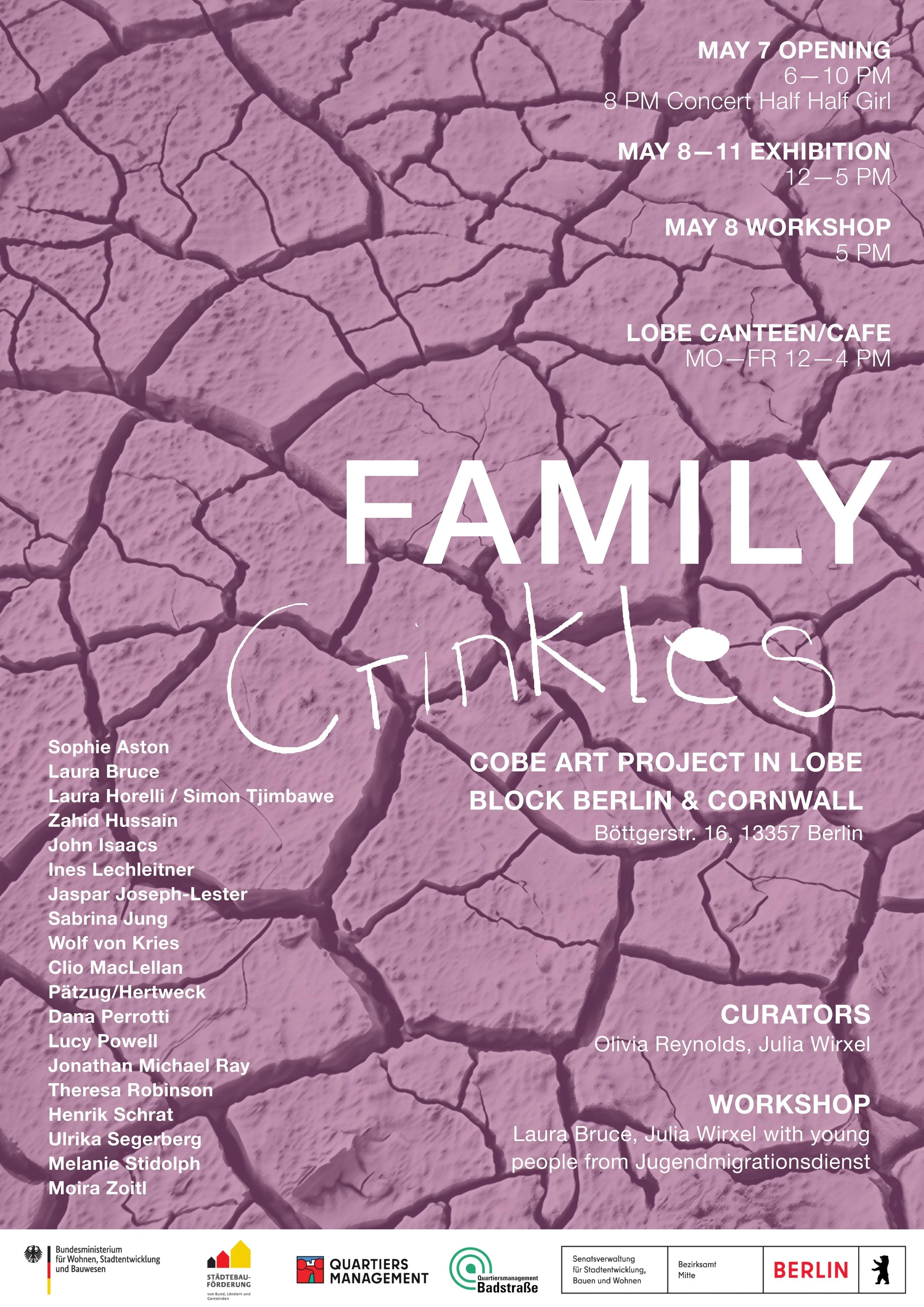
Family Crinkles
Sophie Aston, Laura Bruce, Laura Horelli/Simon Tjimbawe, Zahid Hussain, John Isaacs, Sabrina Jung, Jaspar Joseph-Lester, Wolf von Kries, Ines Lechleitner, Clio MacMellan, Pätzug/Hertweck, Dana Perrotti, Lucy Powell, Jonathan Michael Ray, Theresa Robinson, Henrik Schrat, Ulrika Segerberg, Melanie Stidolph, Moira Zoitl
Curated by Olivia Reynolds & Julia Wirxel
“Family is a thing one can rub up against, no matter where it is.” (Benjamin von Wyl)
How have our earliest experiences influenced us and formed our identities? How do we remember them? How do we feel when we do? These are the questions the artists of the Family Crinkles exhibition answer in various ways, interrogate further, and use to inspire bright ideas in viewers.
Everyone is affected by the question of how we live within the constellations of society and the related norms and rules. Do family structures foster trust and mutually fortifying communities, or do members lose each other, live parallel lives, drift apart and fall out of contact? "A functional family is the healthy soil out of which individuals can become mature human beings." (bell hooks). Self-esteem is learned, autonomy and dependence exist in harmony and yet are often under constant renegotiation. Usually, we associate the term ‘family’ with a sense of ambivalence.
Since the 1980s, significance has accreted around the concepts of dysfunctional families and the inner child. In 2026, the question is being asked afresh: how do we perceive the family? ‘Family’ has become increasingly pluralistic and open. It can be more generously defined in line with our perceptions and experiences - beyond the (civic) nuclear family, we have ‘patchwork’ and ‘bonus’ families and even ‘found’ and 'chosen’ families consisting of friends or cohabitants. Other concepts such as parentification and empowered mothering are also increasingly relevant in today’s discourse.
Family is also a location of social disparities. Social divisions and class differences are perpetuated. Especially currently, resilience to and management of uncertainty and complexity are central aspects that define the present. Apparently quick and simple solutions and the insistence on dualism do not lead to a human oriented world in which one would wish to live. The realms of paid labour and unpaid care work still collide with each other and reproduce gender stereotypes which are politically, structurally, societally and emotionally supported and demand strength and reflection to address.
And the cycle begins again within the family and is carried on. How we raise our children, sons, and daughters, is critical to the future of society. Are we equal role-models?
Do they lose themselves in the binaries of social media, and disregard the remaining decency of the analogue world? How will they shape the world in their youth and as adults? The source of affirmation in the family is love. Should this and other sources of affirmation be missing, (digital) violence can become an attractive alternative.
Since the middle of the 19th century, marriage and family have changed. Once the purpose of such connections was the reproduction of social norms and attainment of economic goals and not the personal development of the individual. Despite the definitions of family and marriage being strongly influenced by the inequality of the sexes, this became a space where the relationships between family members grew more emotional.
This intimacy drove individualisation and was elevated to an ideal between the partners: a (marriage) contract as an emancipatory act of union between two people from a position of free will. A further impetus for the changing nature of family in the age of modernity was a novel ideal: that of authenticity, which was itself driven by intimacy. Intimacy as an experienced interiority, the emergence of psychology and the parallel investigation of the emotional inner-life, emphasised subjectivity over hierarchy and could be viewed as anti-establishment. Voluntary relationships entered by two ‘I’s, are complex and from the 1970s demanded the concept of communication between partners and members of a community / family. This continues to this day. Crises, wars and migrations also have their effects on individual family members. Happily, there is no reduction of the complexity within families and chosen families in sight. Many people have the possibility and the freedom to choose how they define and live family.
Several artists in this exhibition use the media of photography, film and video in their work. Susan Sontag suggested that photography means engaging with the mortality, vulnerability and alterability of humans (or things). The unstoppable progress of time becomes visible in them.
Coagulated emotions and memories as well as physical landscapes can be found in all works of the exhibition. They show themselves in the installations, (three-dimensional) paintings, (site specific) wall works, drawings, collages, objects and an ephemeral scent.
Laura Bruce uses coloured pencils to draw large format memories of her childhood in Georgia. In the series entitled The Droplet Machines, raindrops and tears are perceptible through abstraction. Pätzug/Hertweck, contemplate the mysterious and invisible with their flowing and circulating curtain, which floats enchanted through space and allows or blocks glimpses (of a bathtub): a multilayered construction of memories, repetitions and displacements.
In her (video-) installation, Moira Zoitl reveals an autobiographically inspired development of and reflection on anti-authoritarian upbringing and the creation of a parent organised kindergarten. The uncanny doll-mothers in Sabrina Jung’s photo-collages gesture towards the corset of future feminine expectations. Works newly produced for the exhibition become three-dimensional: 3D printing is among the media used by the artist.
Jonathan Michael Ray’s work Pilgrim is a collection of every-day objects left to him by his grandmother, which he has arranged into a kind of bird house. The artist’s daughter swallowed a gold coin in the Orkney Islands and had to be brought to the emergency room. The x-ray of the 3 year old child becomes a relic in the piece Shroud. Storm Stones is based on a drawing by his daughter which he further developed and engraved on a stone slab. Over the course of years, in her free time, Jasper Joseph-Lester’s mother photographed a cliff face in Cornwall. He has printed this found footage and arranged it in her memory. Melanie Stidolph engages with women who are unwillingly childless and therefore can’t start a family - in video, photography printed on fabric, dresses as relicts of a performance and a flag on the roof of the Lobe Block.
For a farewell ceremony for Olivia Reynolds’ grandmother in Sweden, Ines Lechleitner interviewed relatives of the departed to create a scent that represented her personality. This fragrance was worn by all those present at the event. The scent and the book containing pictures of the ritual are part of the exhibition and, in a spiritual way, allow the departed to live again.
Henrik Schrat often incorporates fairytales into his work. In the site specific wall work developed for this exhibition, imagined spaces collected by him and several relatives are made visible. Dreamlike, the mural reflects the stories, objects, and spaces, which for a certain time, had meaning in the shared life of a family.
The raw material of Sophie Aston’s collages is based on the pages of the Better Homes and Gardens Magazine, deconstructed through idiosyncratic interference with the spotless domestic environment. As with Pätzug/Hertwerk, curtains play a role, in Sophie Aston’s case bringing Martha Rosler to mind.
Laura Horelli/Simon Tjimbawe collaborate in their video piece In the Beginning There Was Cultural Identity (2023). A museum in Braunschweig is exhibiting a belt which belonged to Kahimemua, which will soon be restored to Namibia. Kahimemua, a chief of the Ovambanderu, was executed by German colonists in 1896. As Simon Tjimbawe’s family is related to that of Kahimemua, he is posed a series of questions. The conceptual photo project Daniel Munamava Street (2026) is titled after a street in Windhoek which, after Namibian independence in 1990, was renamed from Göring Street to Daniel Munamava Street after Simon Tjimbawe’s uncle, a political activist.
In his new work Give birth to your own gods and bury your own demons John Isaacs considers the foot as an instrument of forward progress, but also as a location of the burden carried. The two other elements of the wall-mounted sculpture offer nature as a conceptual space, a possibility of growth and simultaneously limitation, an inhibition of development for example through family duties or fates, that have their effects on a life. Care work, often invisible, is also a part of the family. Wolf von Kries displays a new perspective on cleaning cloths which, neatly folded, have been pressed, perhaps ‘ironed’, with an old cobblestone. This reveals an arresting contrast between the soft material intended for use within the home and the hard stone, drawn from the public space of the street.
Ulrika Segerberg is a painter also working with video and three-dimensional media. Her canvases are constantly spatially arranged to create geometric bodies of humans, but also of animals, who can equally become part of families. Theresa Robinson displays three papercuts of ancestors of the artist and curator Olivia Reynolds created in 1830. She worked with delicate incisions.
On the roof terrace can be found a symbol which binds Dana Perrotti closely to her family: a distorted rainbow. The imperfection of the rainbow links it with the equally imperfect world. Zahid Hussain has created a new mural for the roof terrace. His work is often concerned with the subject of homelessness, which he himself experienced as a refugee in Italy, separated from his family.
Lucy Powell uses slides to investigate the family relationships and physical similarities of sheep. This links to the work of Clio MacLellan, who also works with material from sheep: their wool. Every year, she helps her family with lambing and has processed this experience in the creation of a woven landscape tapestry. The quilt sewn out of sugar sacks refers to her own life as an artist, during which she took a job in a cinema. These bags are a memento of how she earned her daily bread (and sugar). When working on it she discovered that her grandmother also recycled sugar sacks, sewing them into carpets.
Birds of a feather…
Julia Wirxel
Translation: Josephine Nolan